 IMH Navigator
Initial Assessment and Response - Emergency Response Actions
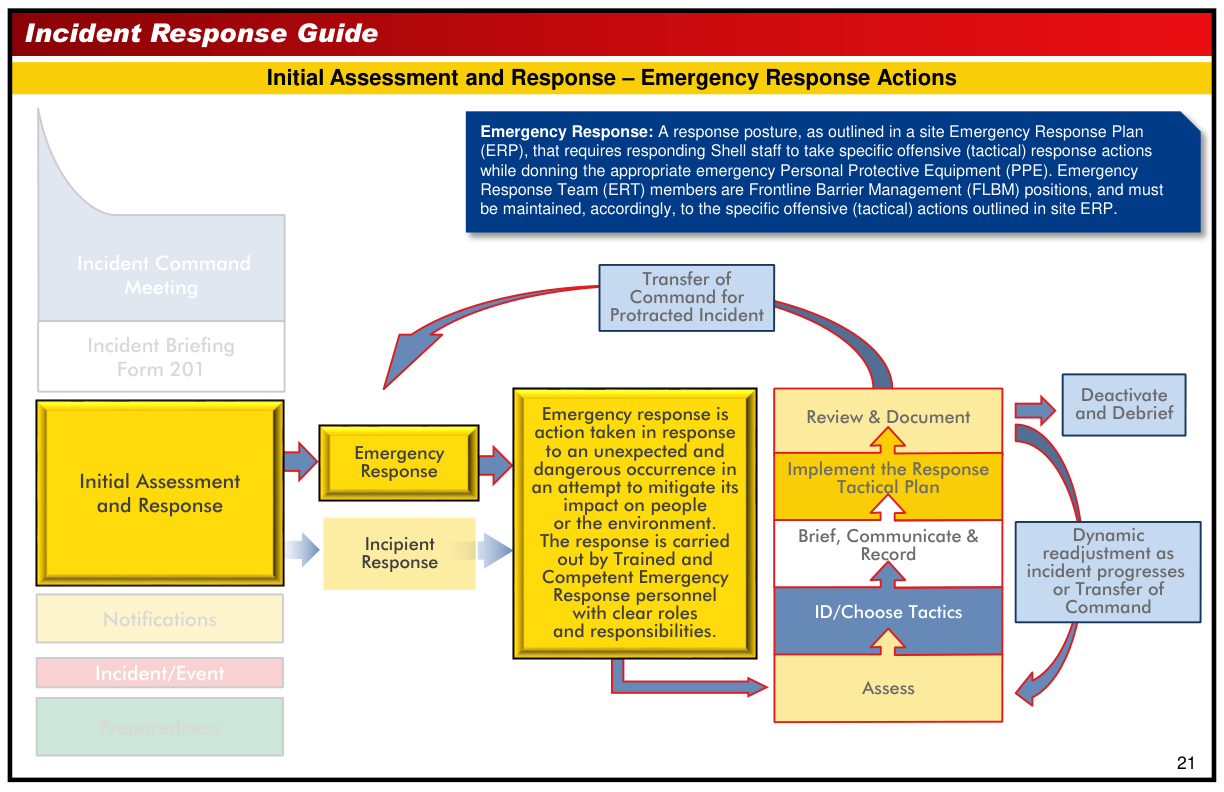
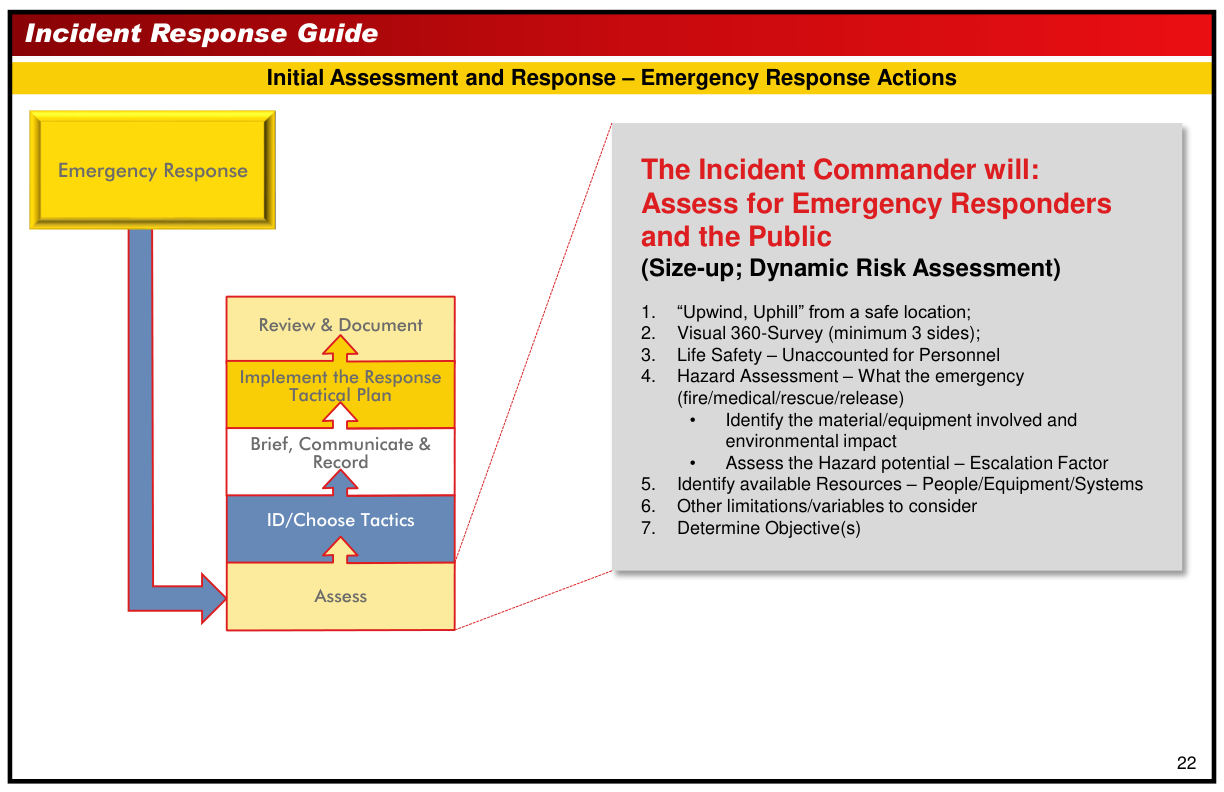
The Incident Commander will: Assess for Emergency Responders and the Public (Size-up; Dynamic Risk Assessment)
- "Upwind, Uphill" from a safe location;
- Visual 360-Survey (minimum 3 sides);
- Life Safety - Unaccounted for Personnel
- Hazard Assessment - What the emergency (fire/medical/rescue/release)
- Identify the material/equipment involved and environmental impact
- Assess the Hazard potential - Escalation Factor
- Identify available Resources - People/Equipment/Systems
- Other limitations/variables to consider
- Determine Objective(s)
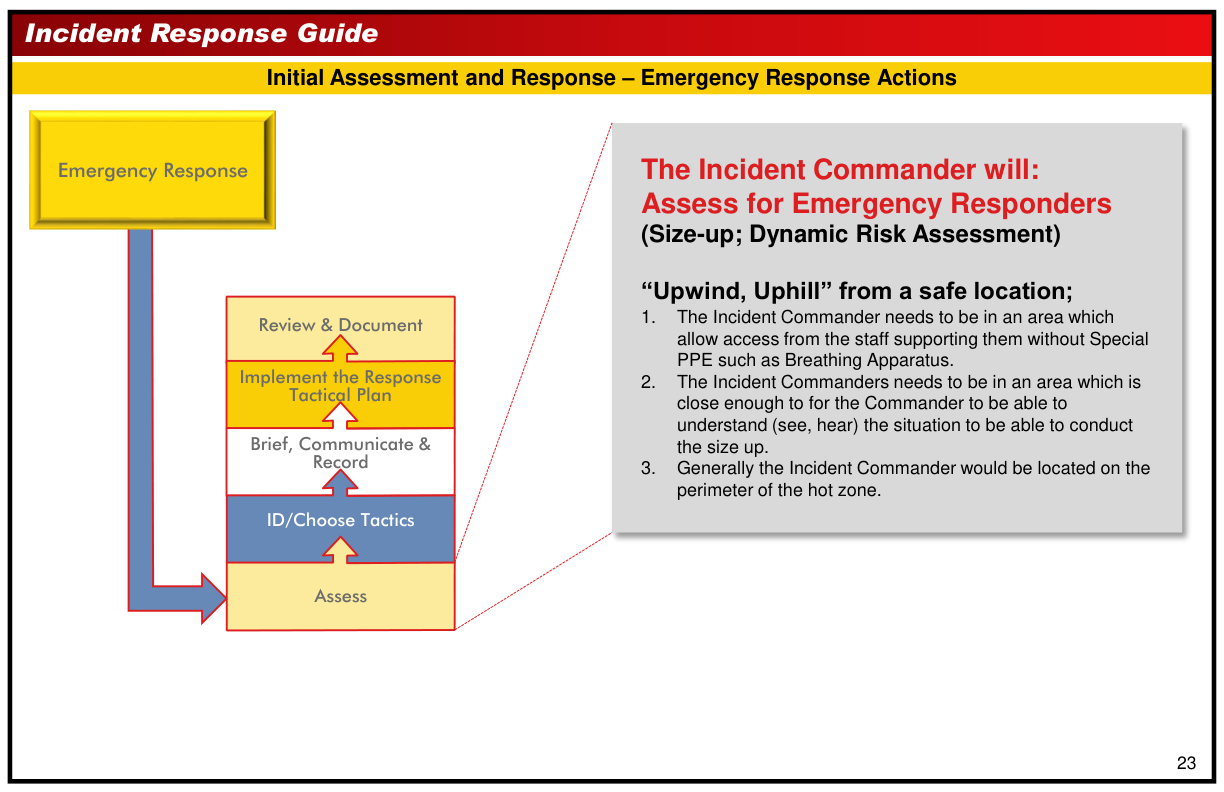
The Incident Commander will: Assess for Emergency Responders (Size-up; Dynamic Risk Assessment)
"Upwind, Uphill" from a safe location;
- The Incident Commander needs to be in an area which allow access from the staff supporting them without Special PPE such as Breathing Apparatus.
- The Incident Commanders needs to be in an area which is close enough to for the Commander to be able to understand (see, hear) the situation to be able to conduct the size up.
- Generally the Incident Commander would be located on the perimeter of the hot zone.
Emergency Response
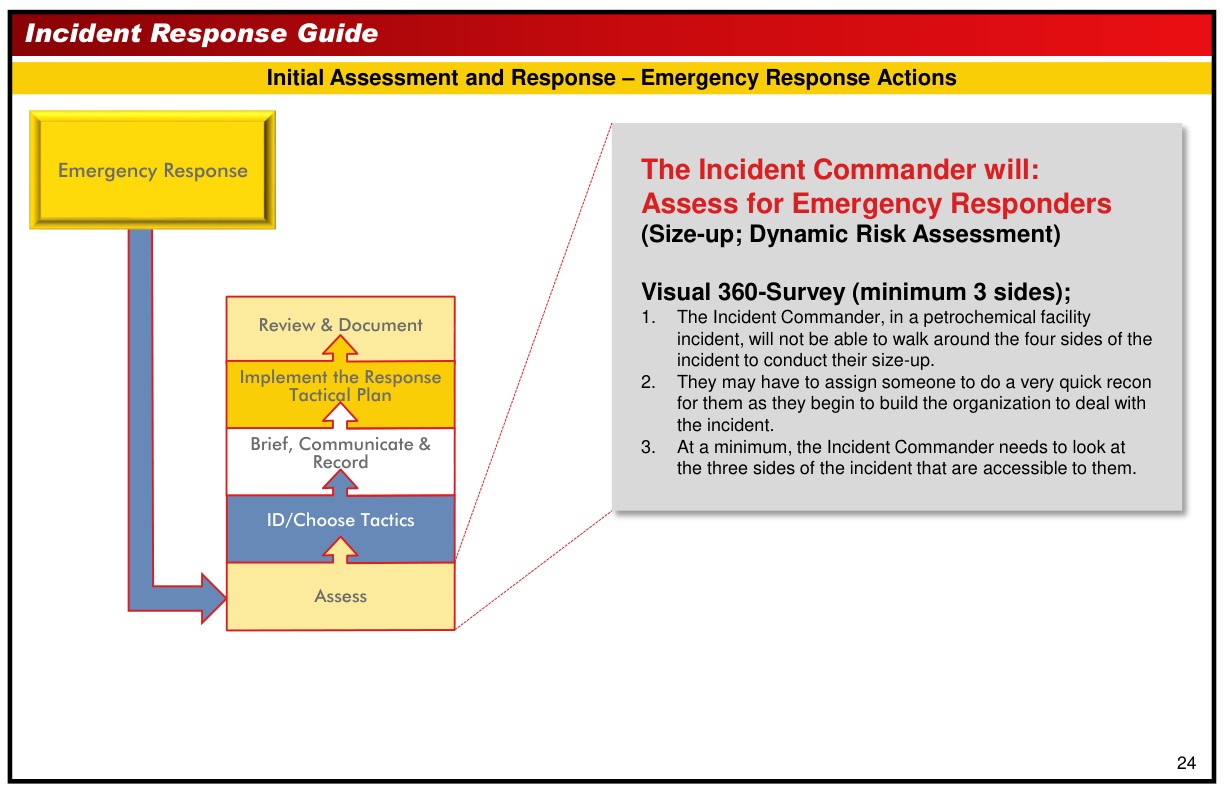
The Incident Commander will: Assess for Emergency Responders (Size-up; Dynamic Risk Assessment)
Visual 360-Survey (minimum 3 sides);
Review & Document
- The Incident Commander, in a petrochemical facility incident, will not be able to walk around the four sides of the incident to conduct their size-up.
Implement the Response Tactical Plan
- They may have to assign someone to do a very quick recon for them as they begin to build the organization to deal with the incident.
Brief, Communicate & Record
- At a minimum, the Incident Commander needs to look at the three sides of the incident that are accessible to them.
ID/Choose Tactics
Assess
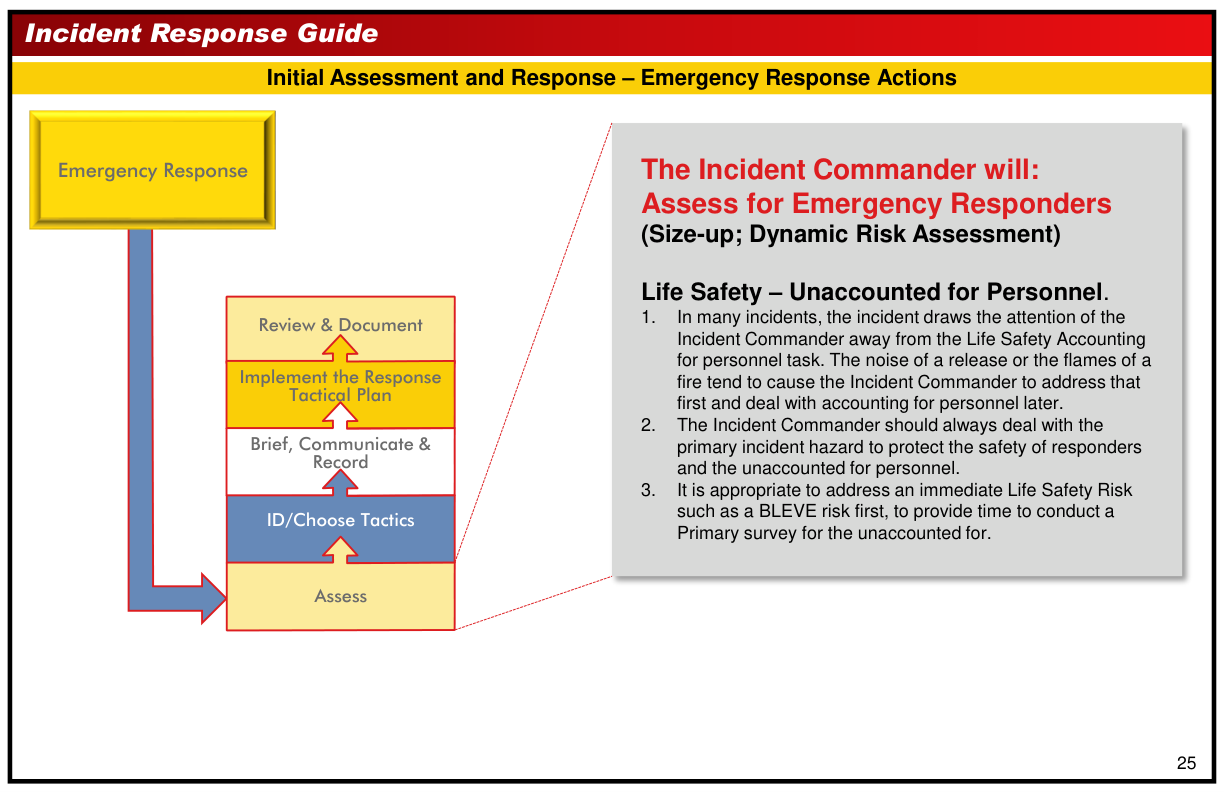
The Incident Commander will: Assess for Emergency Responders (Size-up; Dynamic Risk Assessment)
Life Safety - Unaccounted for Personnel.
- In many incidents, the incident draws the attention of the Incident Commander away from the Life Safety Accounting for personnel task. The noise of a release or the flames of a fire tend to cause the Incident Commander to address that first and deal with accounting for personnel later.
- The Incident Commander should always deal with the primary incident hazard to protect the safety of responders and the unaccounted for personnel.
- It is appropriate to address an immediate Life Safety Risk such as a BLEVE risk first, to provide time to conduct a Primary survey for the unaccounted for.
Emergency Response
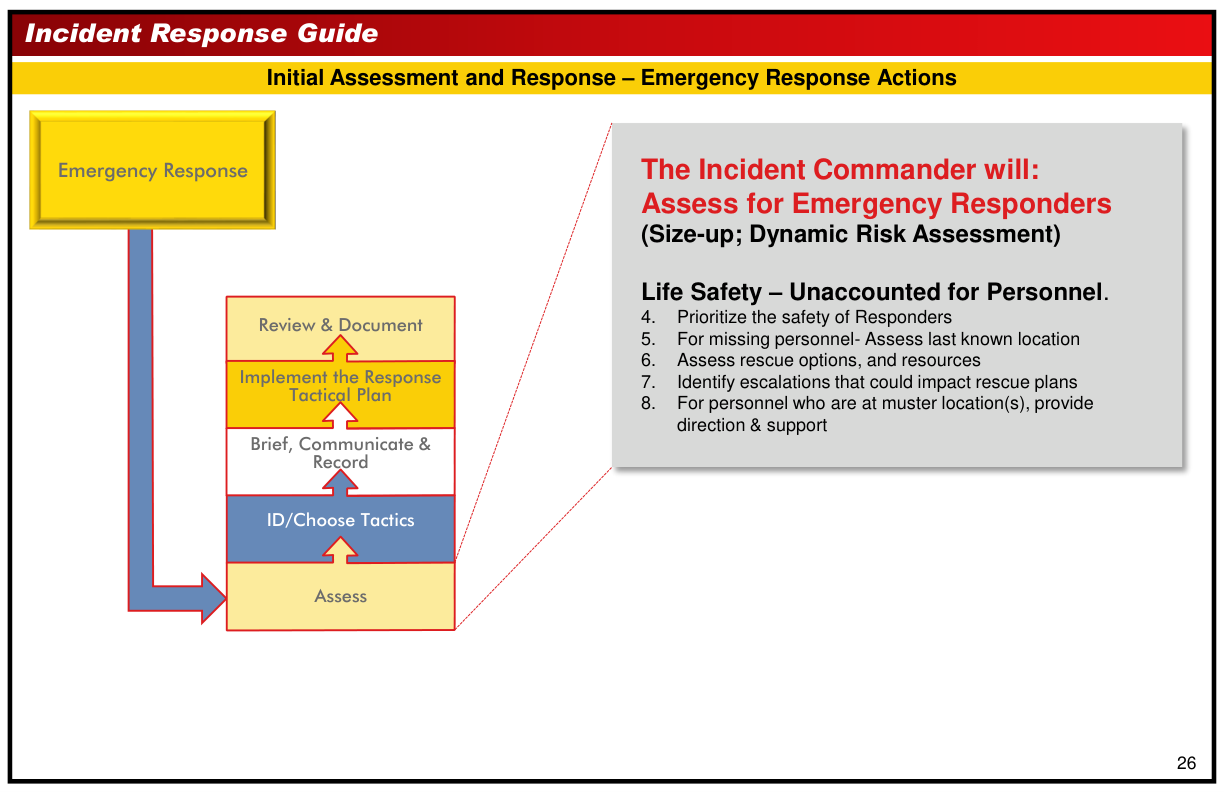
The Incident Commander will: Assess for Emergency Responders (Size-up; Dynamic Risk Assessment)
Life Safety - Unaccounted for Personnel.
Review & Document
- Prioritize the safety of Responders
- For missing personnel- Assess last known location
Implement the Response Tactical Plan
- Assess rescue options, and resources
- Identify escalations that could impact rescue plans
- For personnel who are at muster location(s), provide direction & support
Brief, Communicate & Record
ID/Choose Tactics
Assess
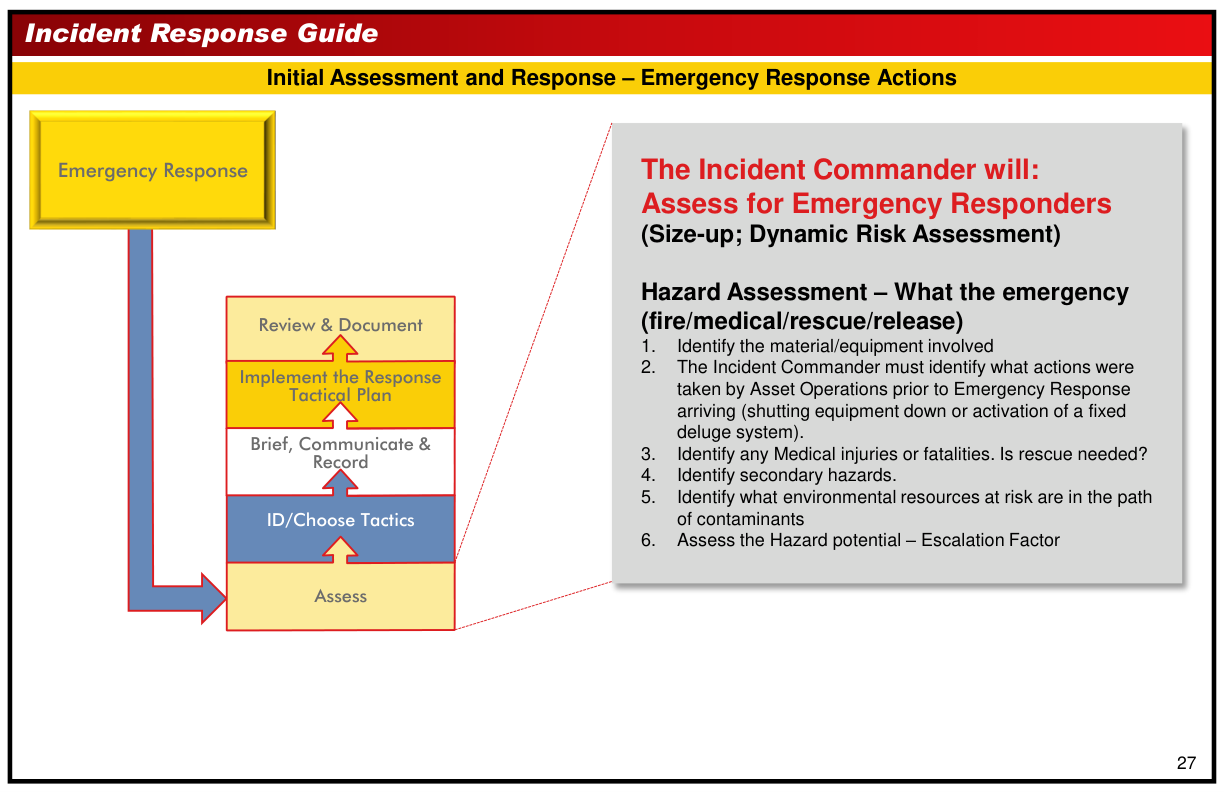
The Incident Commander will: Assess for Emergency Responders (Size-up; Dynamic Risk Assessment)
Hazard Assessment - What the emergency (fire/medical/rescue/release)
- Identify the material/equipment involved
- The Incident Commander must identify what actions were taken by Asset Operations prior to Emergency Response arriving (shutting equipment down or activation of a fixed deluge system).
- Identify any Medical injuries or fatalities. Is rescue needed?
- Identify secondary hazards.
- Identify what environmental resources at risk are in the path of contaminants
- Assess the Hazard potential - Escalation Factor
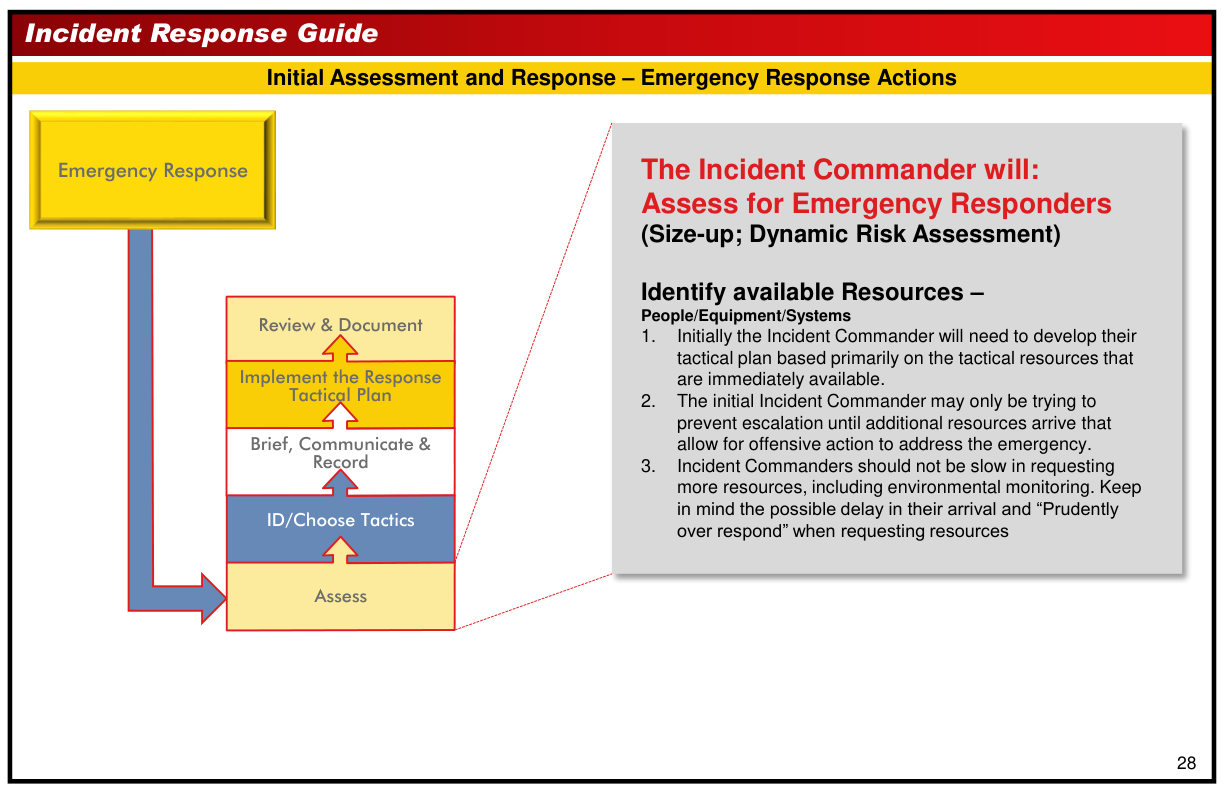
The Incident Commander will: Assess for Emergency Responders (Size-up; Dynamic Risk Assessment)
Identify available Resources - People/Equipment/Systems
- Initially the Incident Commander will need to develop their tactical plan based primarily on the tactical resources that are immediately available.
- The initial Incident Commander may only be trying to prevent escalation until additional resources arrive that allow for offensive action to address the emergency.
- Incident Commanders should not be slow in requesting more resources, including environmental monitoring. Keep in mind the possible delay in their arrival and "Prudently over respond" when requesting resources
The Incident Commander will: Assess for Emergency Responders (Size-up; Dynamic Risk Assessment)
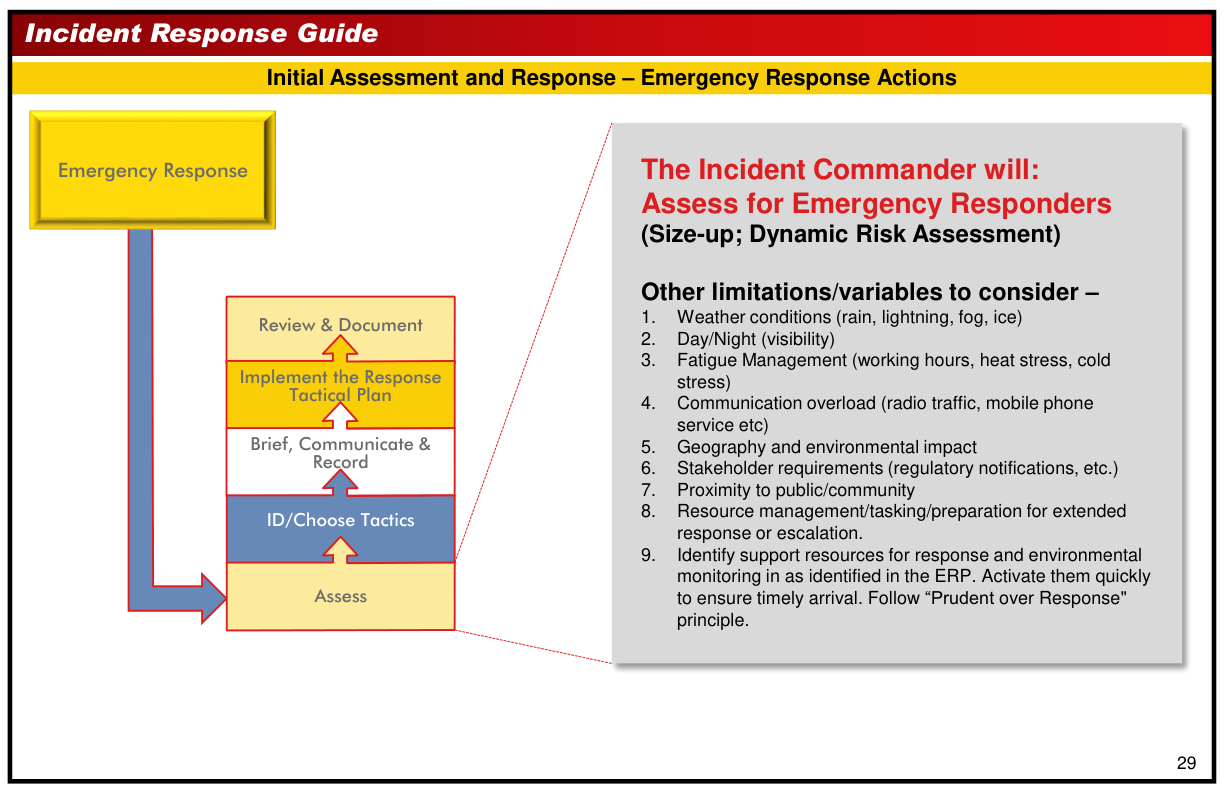
Other limitations/variables to consider -
- Weather conditions (rain, lightning, fog, ice)
- Day/Night (visibility)
- Fatigue Management (working hours, heat stress, cold stress)
- Communication overload (radio traffic, mobile phone service etc)
- Geography and environmental impact
- Stakeholder requirements (regulatory notifications, etc.)
- Proximity to public/community
- Resource management/tasking/preparation for extended response or escalation.
- Identify support resources for response and environmental monitoring in as identified in the ERP. Activate them quickly to ensure timely arrival. Follow "Prudent over Response" principle.
The Incident Commander will: Assess for Emergency Responders (Size-up; Dynamic Risk Assessment)
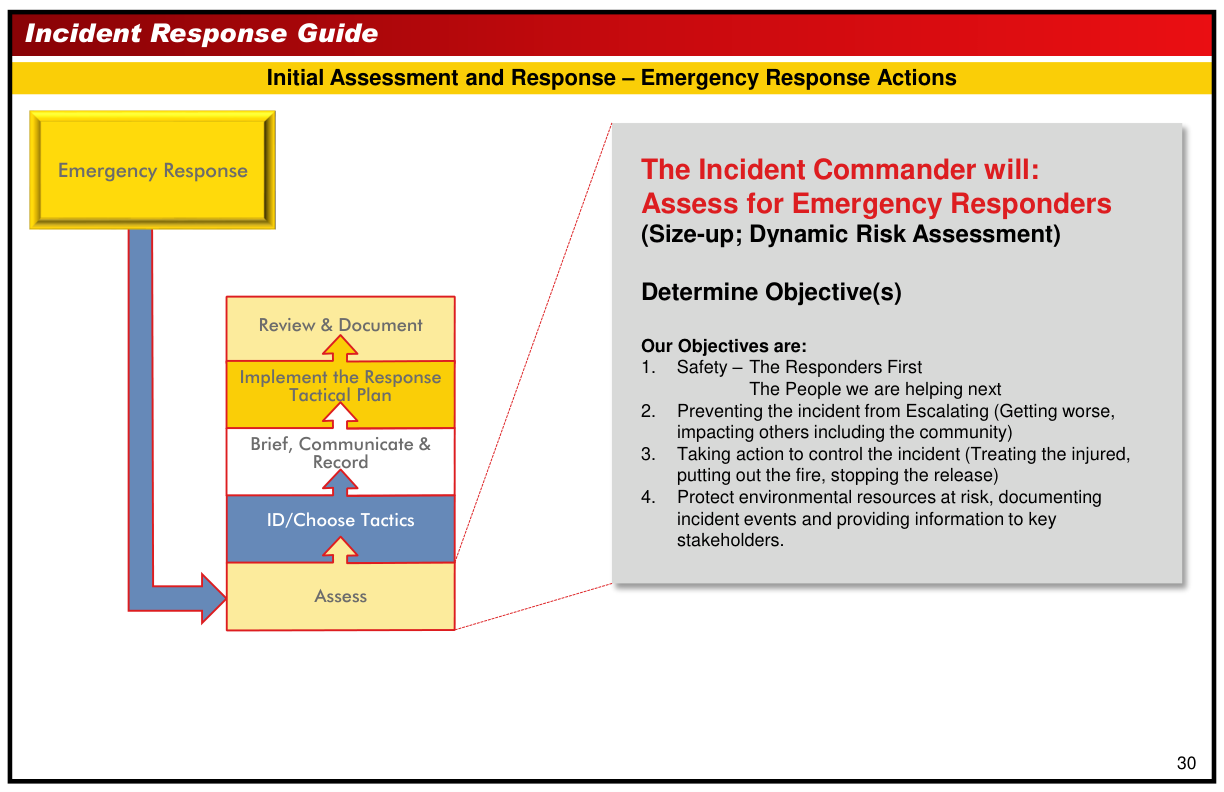
Determine Objective(s)
Our Objectives are:
- Safety - The Responders First The People we are helping next
- Preventing the incident from Escalating (Getting worse, impacting others including the community)
- Taking action to control the incident (Treating the injured, putting out the fire, stopping the release)
- Protect environmental resources at risk, documenting incident events and providing information to key stakeholders.
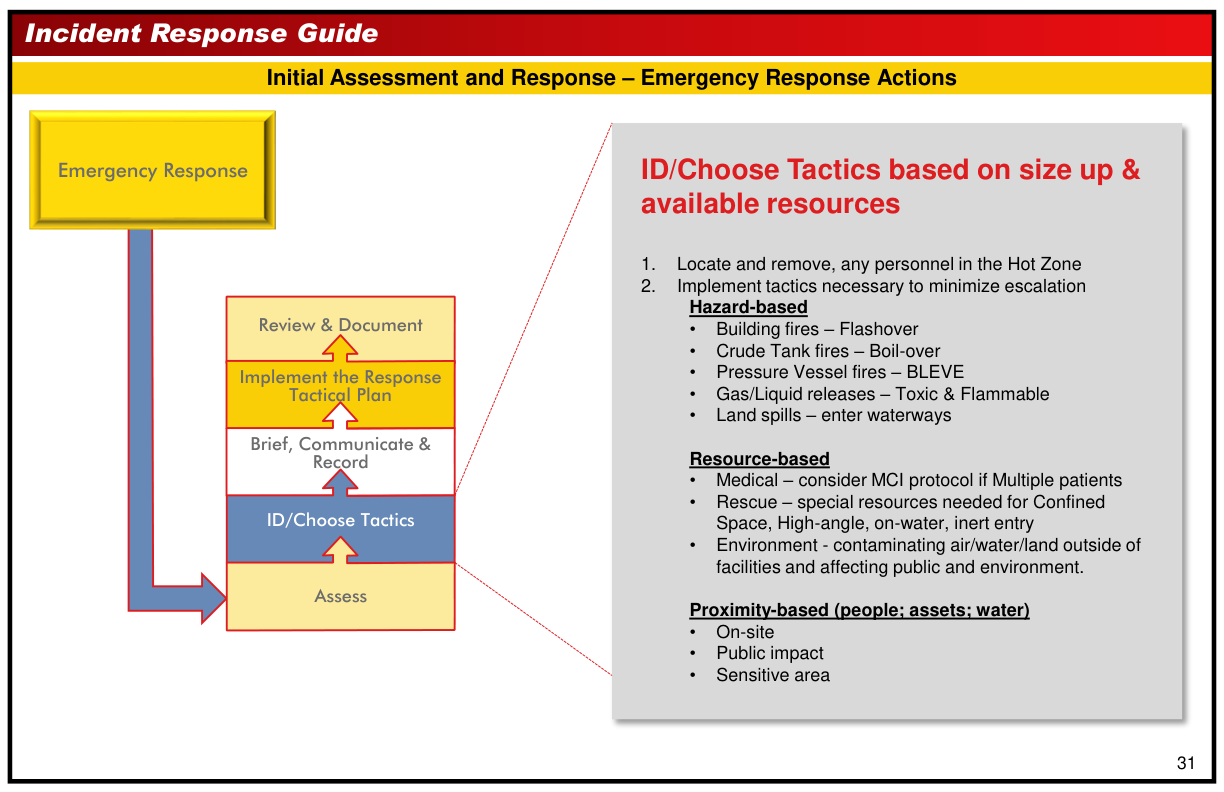
ID/Choose Tactics based on size up & available resources
- Locate and remove, any personnel in the Hot Zone
- Implement tactics necessary to minimize escalation
Hazard-based
- Building fires - Flashover
- Crude Tank fires - Boil-over
- Pressure Vessel fires - BLEVE
- Gas/Liquid releases - Toxic & Flammable
- Land spills - enter waterways
Resource-based
- Medical - consider MCI protocol if Multiple patients
- Rescue - special resources needed for Confined Space, High-angle, on-water, inert entry
- Environment - contaminating air/water/land outside of facilities and affecting public and environment.
Proximity-based (people; assets; water)
- On-site
- Public impact
- Sensitive area
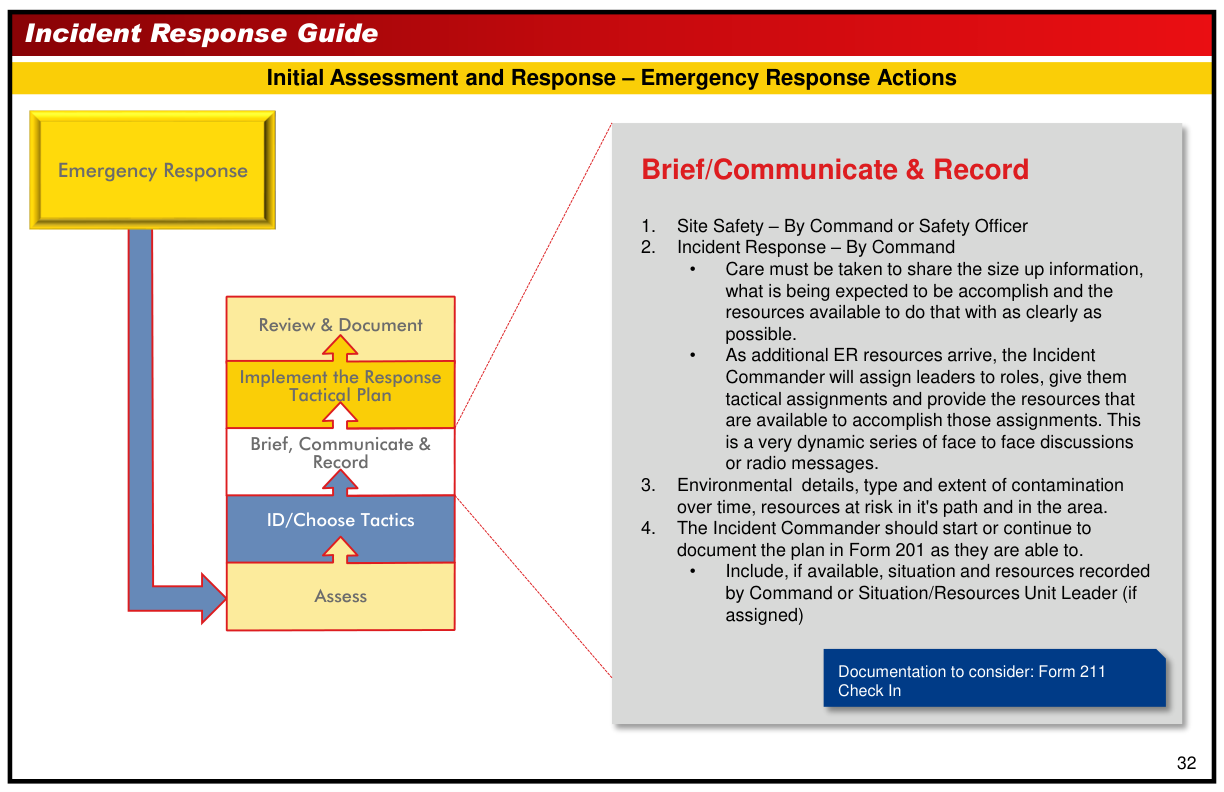
Brief/Communicate & Record
- Site Safety - By Command or Safety Officer
Incident Response - By Command
- Care must be taken to share the size up information, what is being expected to be accomplish and the resources available to do that with as clearly as possible.
- As additional ER resources arrive, the Incident Commander will assign leaders to roles, give them tactical assignments and provide the resources that are available to accomplish those assignments. This is a very dynamic series of face to face discussions or radio messages.
- Environmental details, type and extent of contamination over time, resources at risk in it's path and in the area.
- The Incident Commander should start or continue to document the plan in Form 201 as they are able to.
- Include, if available, situation and resources recorded by Command or Situation/Resources Unit Leader (if assigned)
Documentation to consider: Form 211 Check In
Implement the Response Tactical Plan
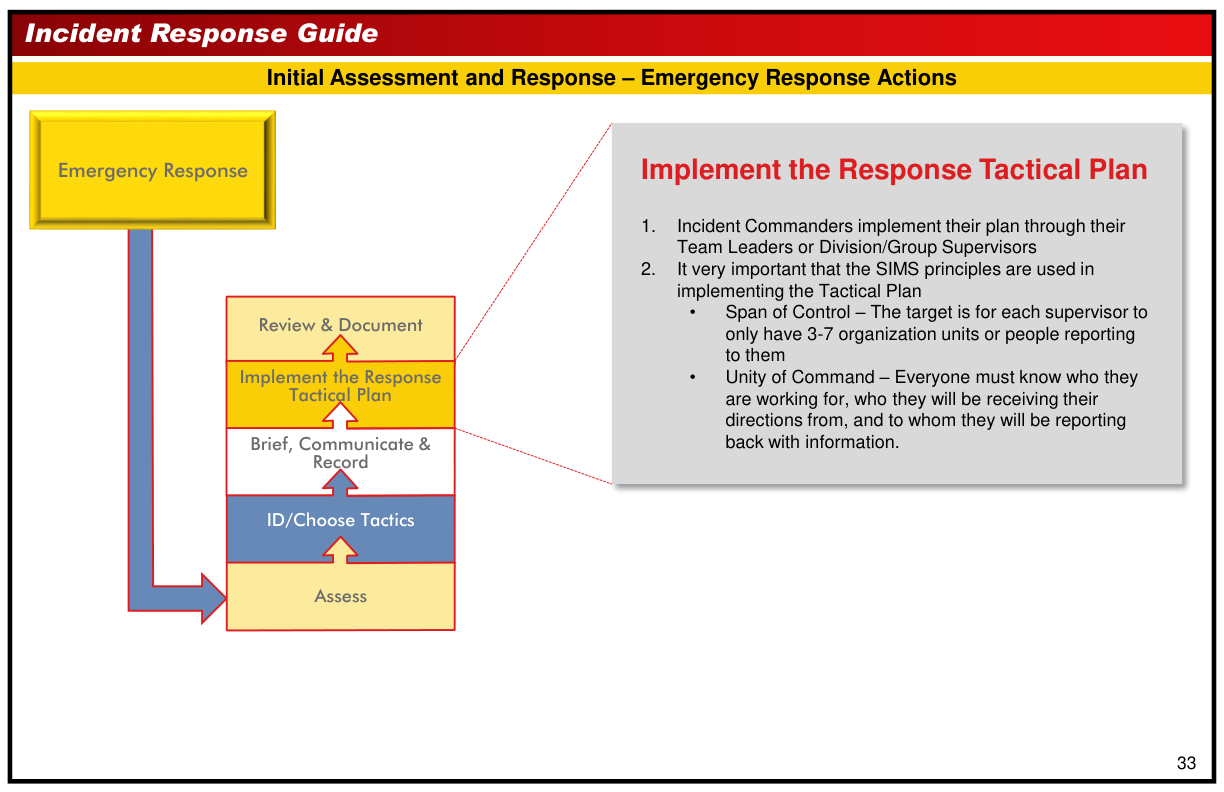
- Incident Commanders implement their plan through their Team Leaders or Division/Group Supervisors
- It very important that the SIMS principles are used in implementing the Tactical Plan
- Span of Control - The target is for each supervisor to only have 3-7 organization units or people reporting to them
- Unity of Command - Everyone must know who they are working for, who they will be receiving their directions from, and to whom they will be reporting back with information.
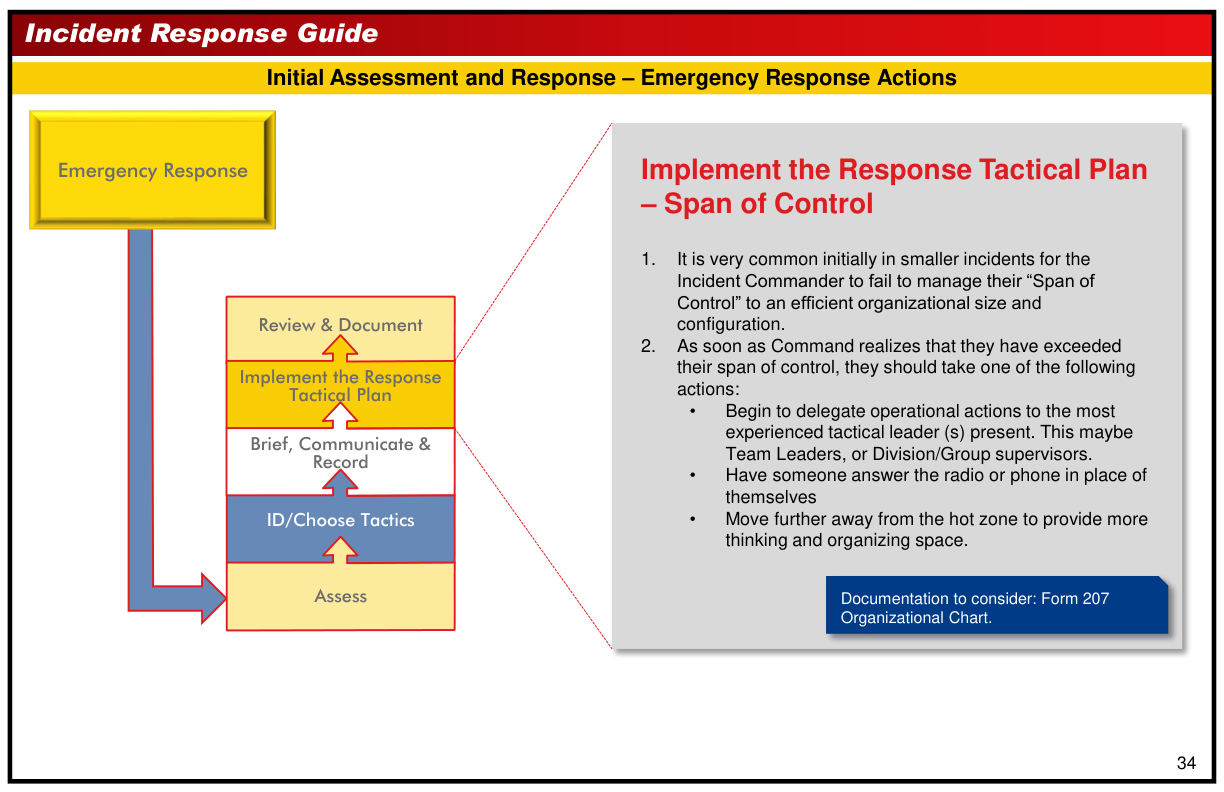
Implement the Response Tactical Plan - Span of Control
- It is very common initially in smaller incidents for the Incident Commander to fail to manage their "Span of Control" to an efficient organizational size and configuration.
- As soon as Command realizes that they have exceeded their span of control, they should take one of the following actions:
- Begin to delegate operational actions to the most experienced tactical leader (s) present. This maybe Team Leaders, or Division/Group supervisors.
- Have someone answer the radio or phone in place of themselves
- Move further away from the hot zone to provide more thinking and organizing space.
Documentation to consider: Form 207 Organizational Chart.
Emergency Response
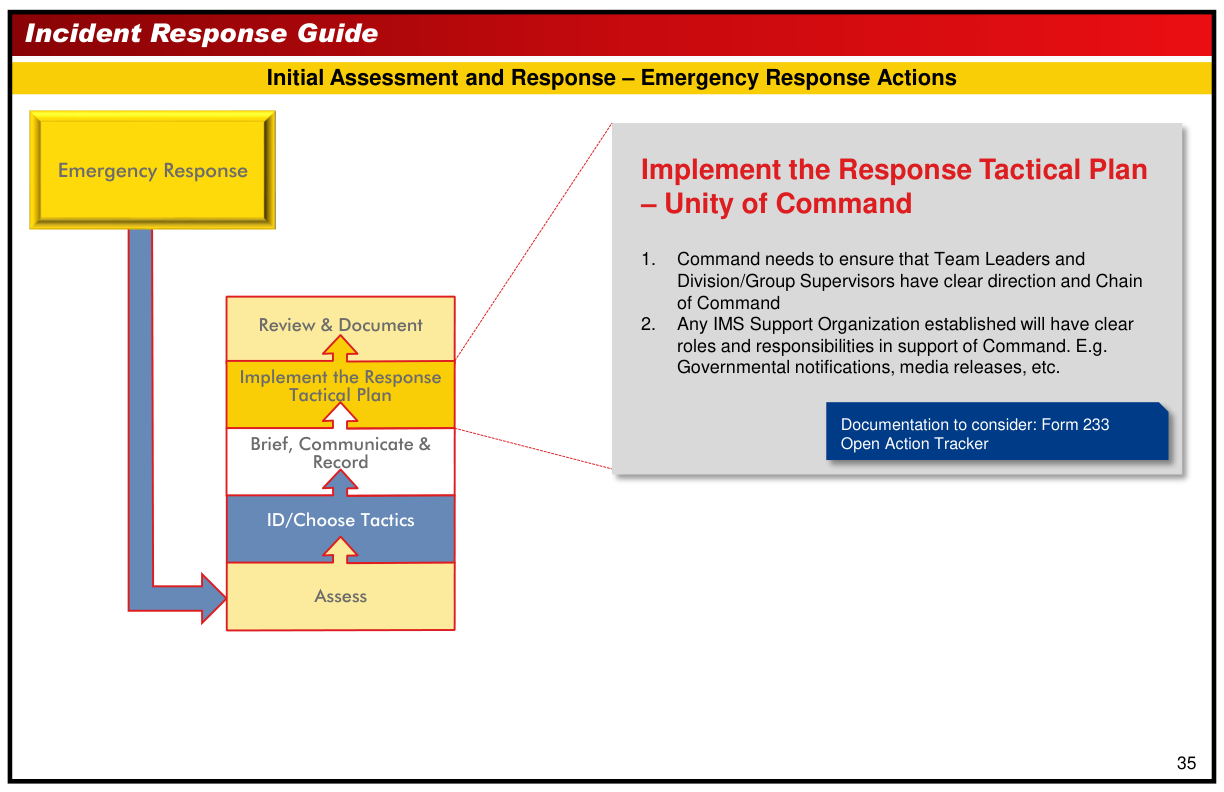
Implement the Response Tactical Plan - Unity of Command
- Command needs to ensure that Team Leaders and Division/Group Supervisors have clear direction and Chain of Command
Review & Document
- Any IMS Support Organization established will have clear roles and responsibilities in support of Command. E.g. Governmental notifications, media releases, etc.
Implement the Response Tactical Plan
Brief, Communicate & Record
Documentation to consider: Form 233 Open Action Tracker
ID/Choose Tactics
Assess
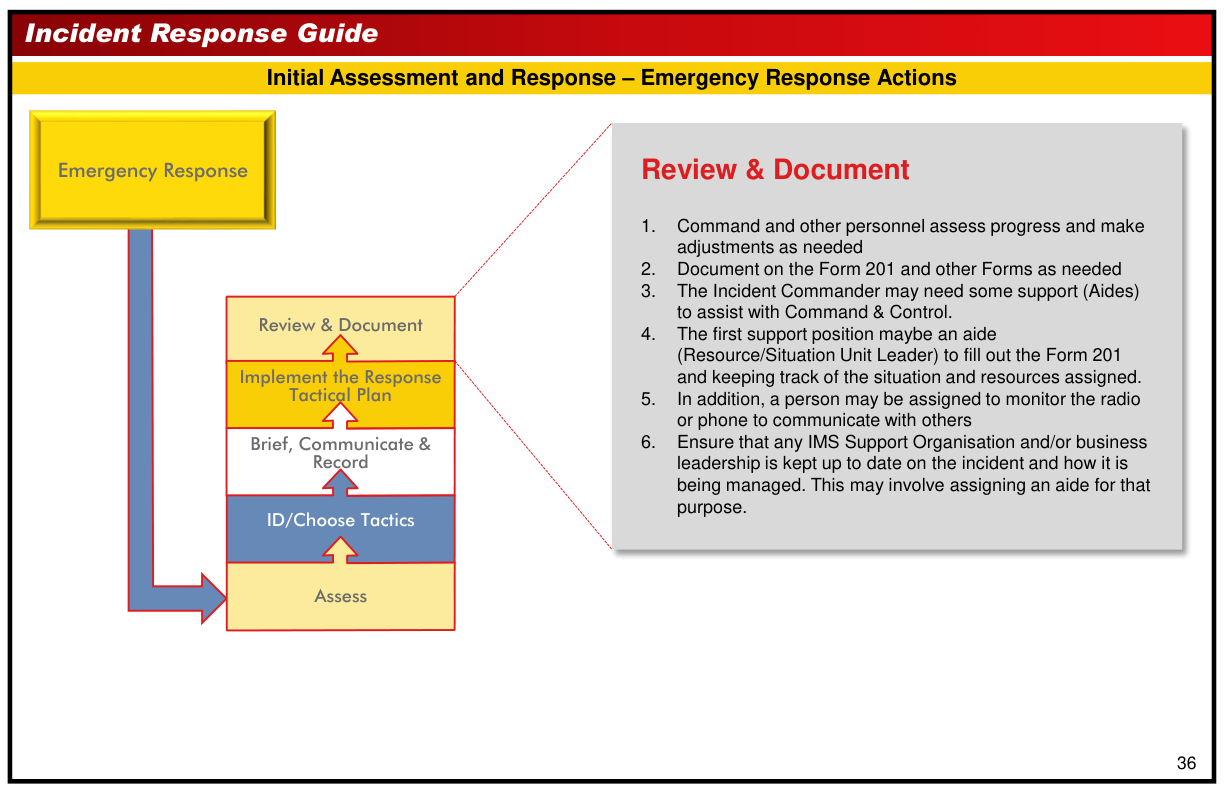
Review & Document
- Command and other personnel assess progress and make adjustments as needed
- Document on the Form 201 and other Forms as needed
- The Incident Commander may need some support (Aides) to assist with Command & Control.
- The first support position maybe an aide (Resource/Situation Unit Leader) to fill out the Form 201 and keeping track of the situation and resources assigned.
- In addition, a person may be assigned to monitor the radio or phone to communicate with others
- Ensure that any IMS Support Organisation and/or business leadership is kept up to date on the incident and how it is being managed. This may involve assigning an aide for that purpose.
| Handbook Page | 21–36 (PDF p.23–38) |
| Part | A — Incident Response |
| Section | 6.3 Emergency Response Actions |
| Type | topic |