 IMH Navigator
Initial Assessment and Response - Incipient Response Actions
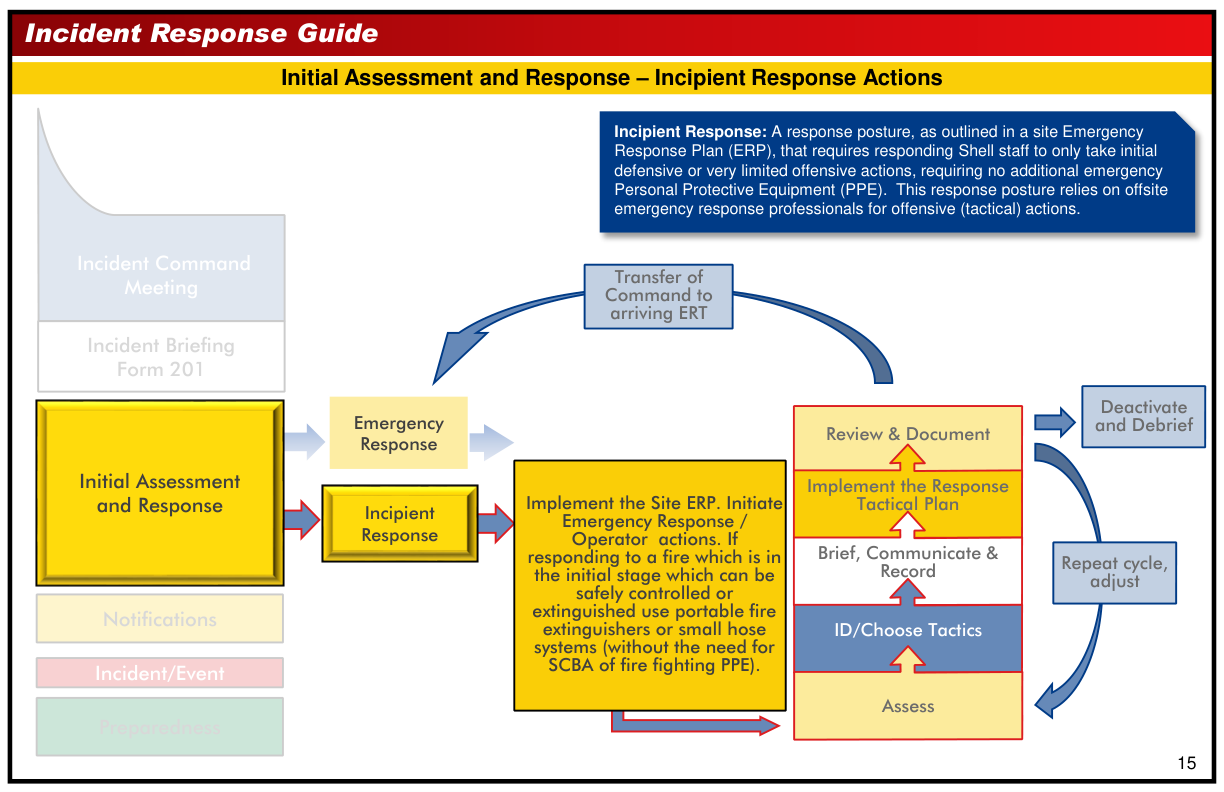
Incipient Response: A response posture, as outlined in a site Emergency, Response Plan (ERP), that requires responding Shell staff to only take initial, defensive or very limited offensive actions, requiring no additional emergency, Personal Protective Equipment (PPE). This response posture relies on offsite, emergency response professionals for offensive (tactical) actions., Incident Command, Meeting, Transfer of, Command to, arriving ERT, Incident Briefing, Form 201, Emergency, Response, Deactivate, and Debrief, Review & Document, Initial Assessment, and Response, Incipient, Response, Implement the Site ERP. Initiate, Emergency Response /, Operator actions. If, responding to a fire which is in, the initial stage which can be, safely controlled or, extinguished use portable fire, extinguishers or small hose, systems (without the need for, SCBA of fire fighting PPE)., Implement the Response, Tactical Plan, Brief, Communicate &, Record, Repeat cycle,, adjust, Notifications, ID/Choose Tactics, Incident/Event, Assess, Preparedness
Incipient Response, Review & Document, Implement the Response, Tactical Plan, Brief, Communicate &, Record, ID/Choose Tactics, Assess
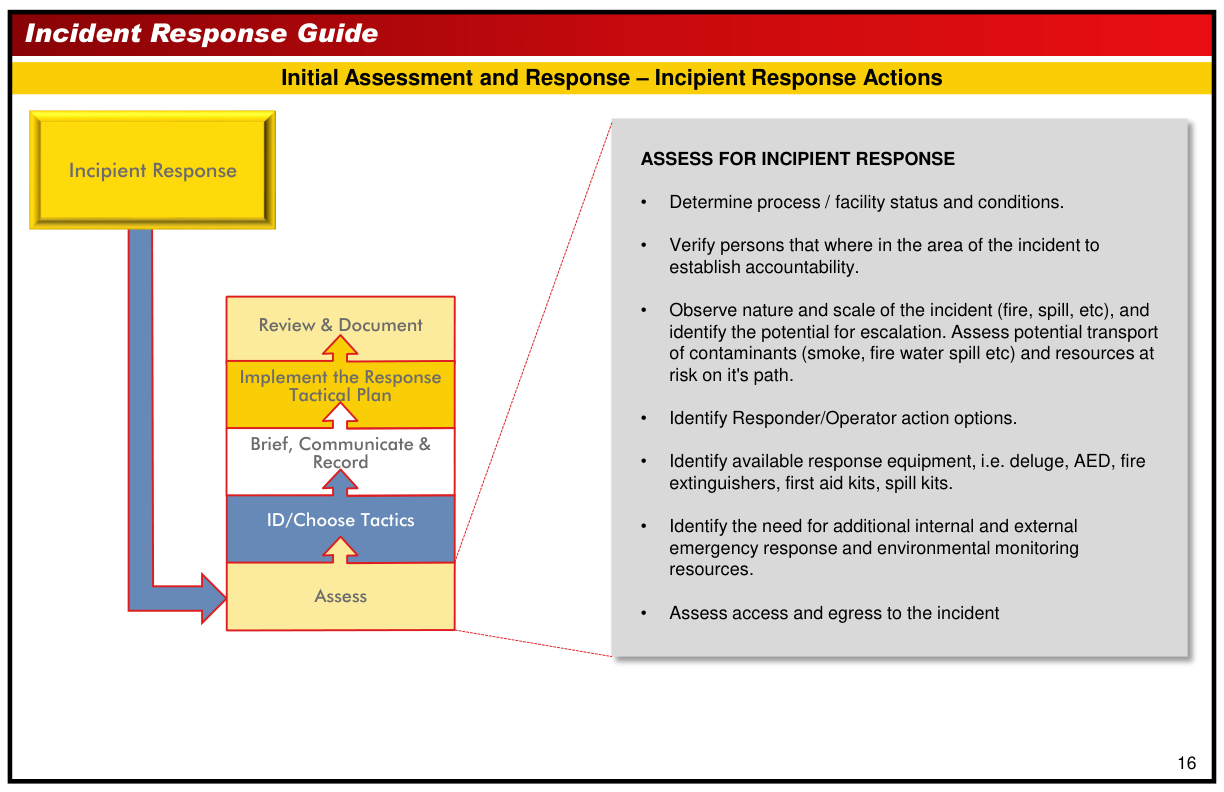
ASSESS FOR INCIPIENT RESPONSE
- Determine process / facility status and conditions.
- Verify persons that where in the area of the incident to establish accountability.
- Observe nature and scale of the incident (fire, spill, etc), and identify the potential for escalation. Assess potential transport of contaminants (smoke, fire water spill etc) and resources at risk on it's path.
- Identify Responder/Operator action options.
- Identify available response equipment, i.e. deluge, AED, fire extinguishers, first aid kits, spill kits.
- Identify the need for additional internal and external emergency response and environmental monitoring resources.
- Assess access and egress to the incident
Incipient Response, Review & Document, Implement the Response, Tactical Plan, Brief, Communicate &, Record, ID/Choose Tactics, Assess
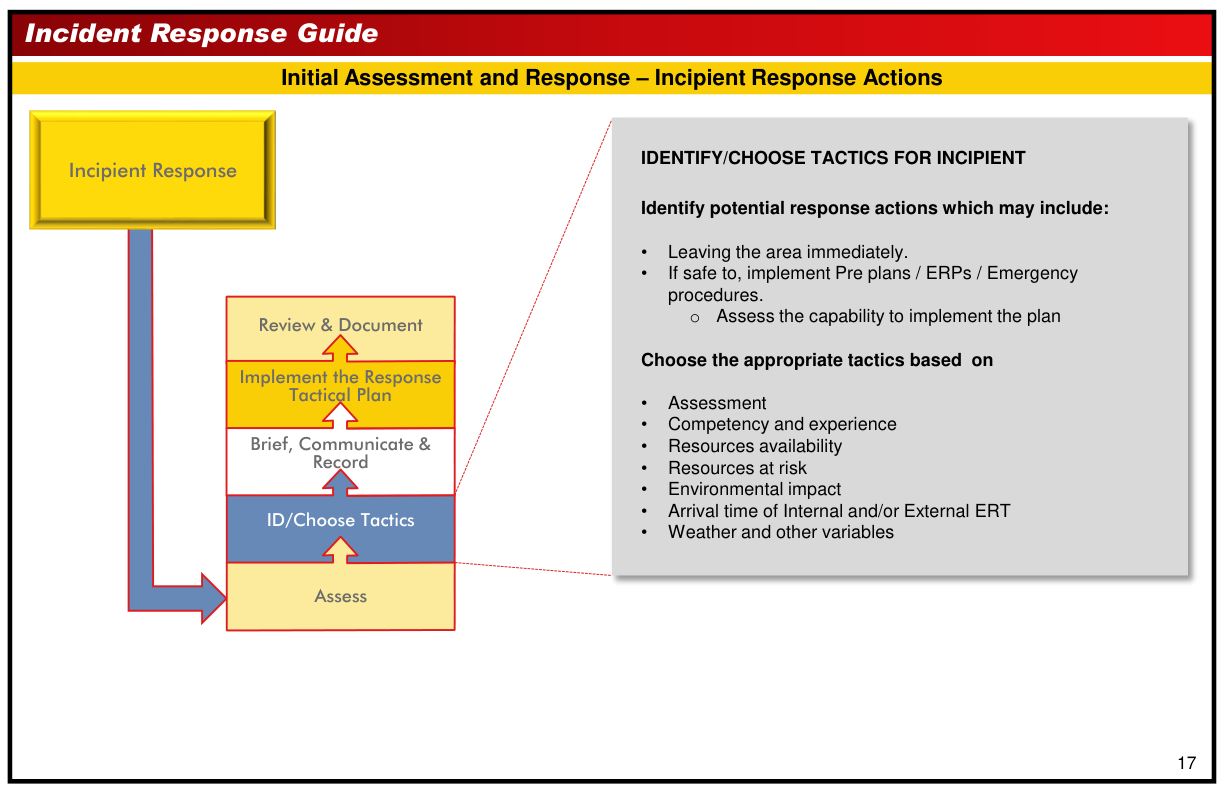
IDENTIFY/CHOOSE TACTICS FOR INCIPIENT
Identify potential response actions which may include:
- Leaving the area immediately.
- If safe to, implement Pre plans / ERPs / Emergency procedures.
o Assess the capability to implement the plan
Choose the appropriate tactics based on
- Assessment
- Competency and experience
- Resources availability
- Resources at risk
- Environmental impact
- Arrival time of Internal and/or External ERT
- Weather and other variables
Incipient Response
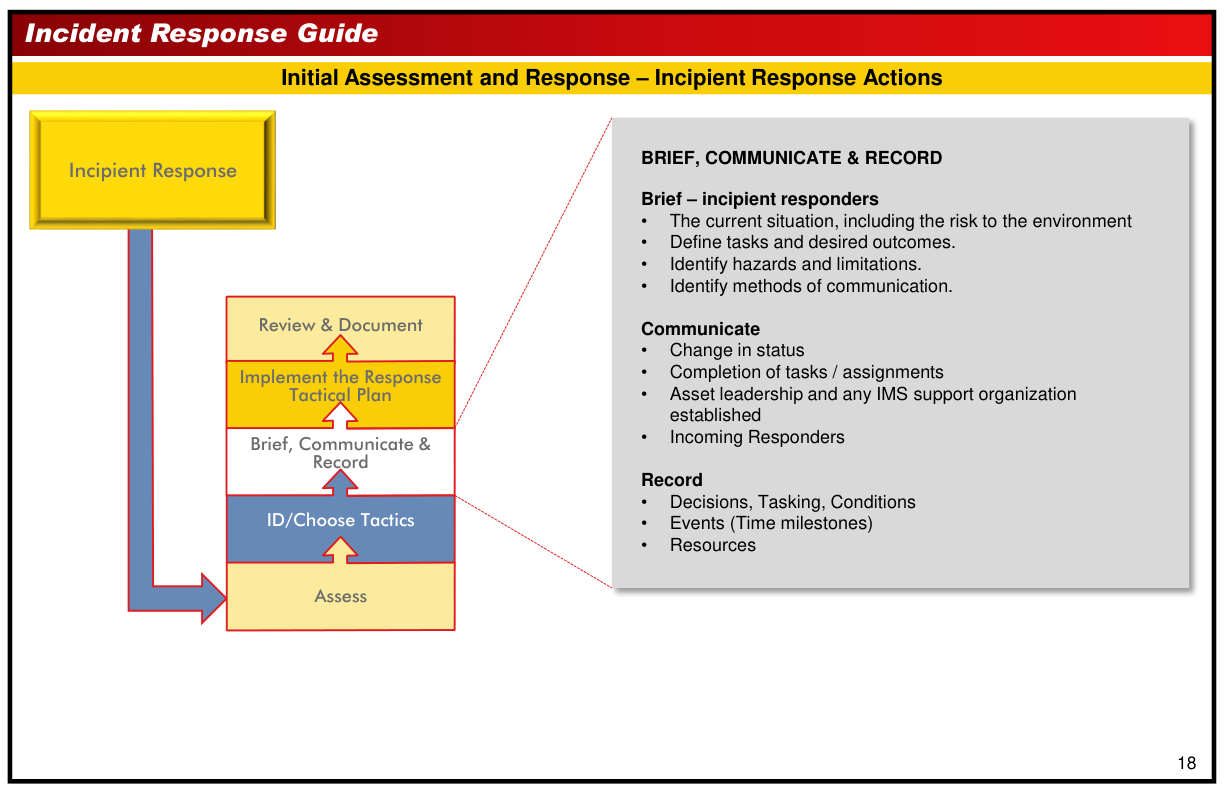
BRIEF, COMMUNICATE & RECORD
Brief - incipient responders
- The current situation, including the risk to the environment
- Define tasks and desired outcomes.
- Identify hazards and limitations.
- Identify methods of communication.
Review & Document
Communicate
- Change in status
Implement the Response Tactical Plan
- Completion of tasks / assignments
- Asset leadership and any IMS support organization established
Brief, Communicate & Record
- Incoming Responders
Record
ID/Choose Tactics
- Decisions, Tasking, Conditions
- Events (Time milestones)
- Resources
Assess
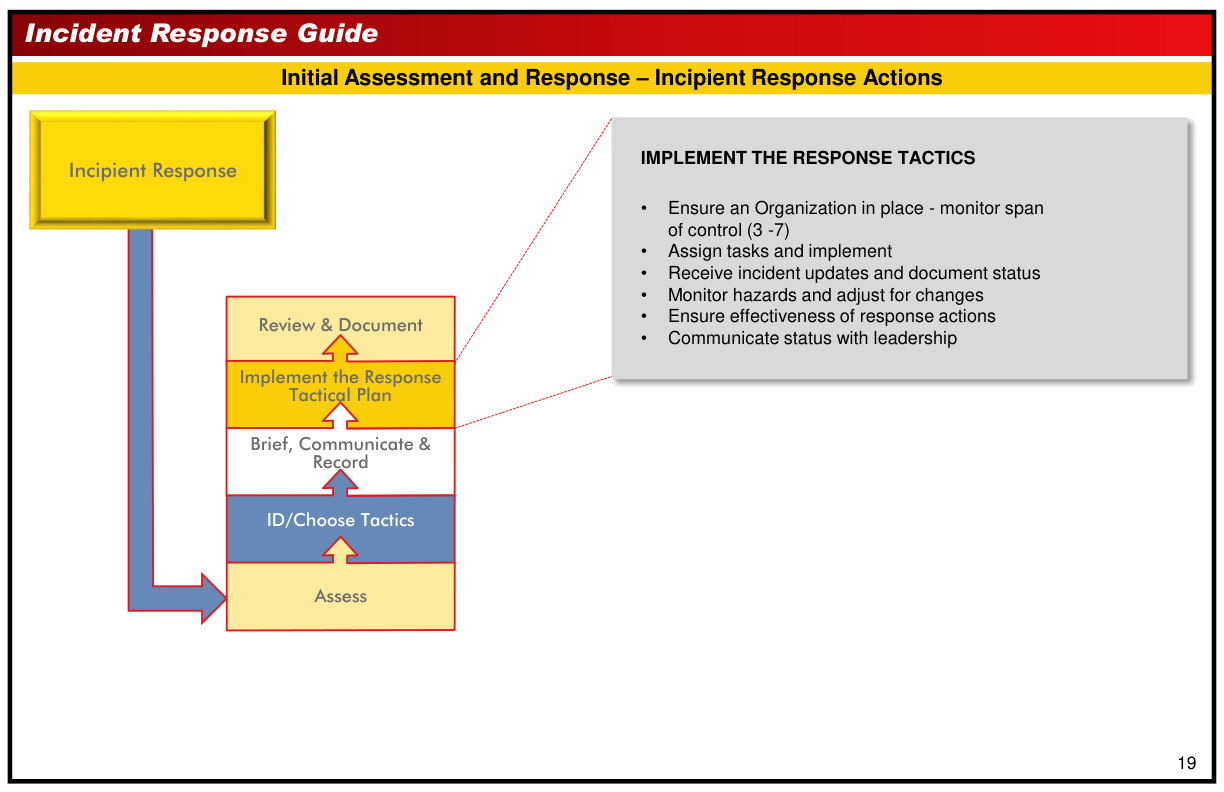
Incipient Response, Review & Document, Implement the Response, Tactical Plan, Brief, Communicate &, Record, ID/Choose Tactics, Assess
IMPLEMENT THE RESPONSE TACTICS
- Ensure an Organization in place - monitor span of control (3 -7)
- Assign tasks and implement
- Receive incident updates and document status
- Monitor hazards and adjust for changes
- Ensure effectiveness of response actions
- Communicate status with leadership
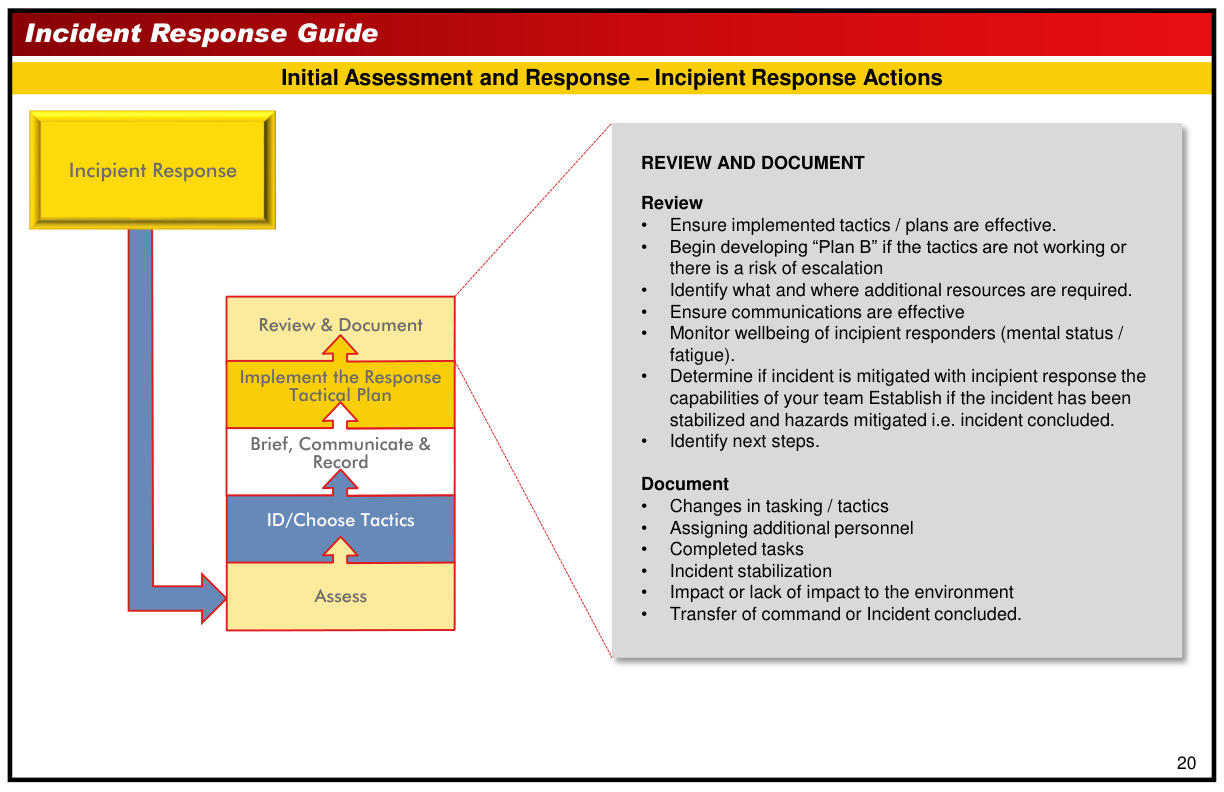
Incipient Response, Review & Document, Implement the Response, Tactical Plan, Brief, Communicate &, Record, ID/Choose Tactics, Assess
REVIEW AND DOCUMENT
Review
- Ensure implemented tactics / plans are effective.
- Begin developing "Plan B" if the tactics are not working or there is a risk of escalation
- Identify what and where additional resources are required.
- Ensure communications are effective
- Monitor wellbeing of incipient responders (mental status / fatigue).
- Determine if incident is mitigated with incipient response the capabilities of your team Establish if the incident has been stabilized and hazards mitigated i.e. incident concluded.
- Identify next steps.
Document
- Changes in tasking / tactics
- Assigning additional personnel
- Completed tasks
- Incident stabilization
- Impact or lack of impact to the environment
- Transfer of command or Incident concluded.
| Handbook Page | 15–20 (PDF p.17–22) |
| Part | A — Incident Response |
| Section | 6.2 Incipient Response Actions |
| Type | topic |