 IMH Navigator
Air Operations Group Supervisors
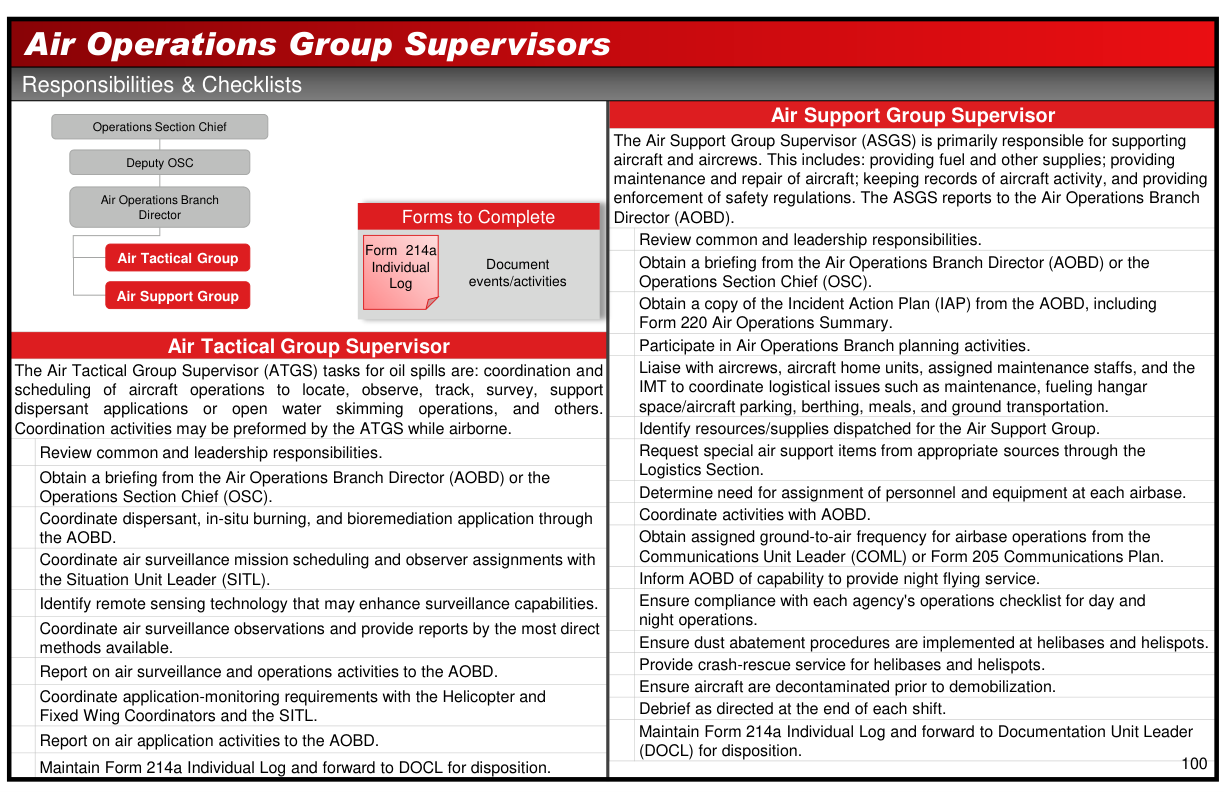
Responsibilities & Checklists
Forms to Complete
Form 214a Individual Log
Document events/activities
Air Tactical Group Supervisor
The Air Tactical Group Supervisor (ATGS) tasks for oil spills are: coordination and scheduling of aircraft operations to locate, observe, track, survey, support dispersant applications or open water skimming operations, and others. Coordination activities may be preformed by the ATGS while airborne.
Review common and leadership responsibilities.
Obtain a briefing from the Air Operations Branch Director (AOBD) or the Operations Section Chief (OSC).
Coordinate dispersant, in-situ burning, and bioremediation application through the AOBD.
Coordinate air surveillance mission scheduling and observer assignments with the Situation Unit Leader (SITL).
Identify remote sensing technology that may enhance surveillance capabilities. Coordinate air surveillance observations and provide reports by the most direct methods available.
Report on air surveillance and operations activities to the AOBD.
Coordinate application-monitoring requirements with the Helicopter and Fixed Wing Coordinators and the SITL.
Report on air application activities to the AOBD.
Maintain Form 214a Individual Log and forward to DOCL for disposition.
Air Support Group Supervisor
The Air Support Group Supervisor (ASGS) is primarily responsible for supporting aircraft and aircrews. This includes: providing fuel and other supplies; providing maintenance and repair of aircraft; keeping records of aircraft activity, and providing enforcement of safety regulations. The ASGS reports to the Air Operations Branch Director (AOBD).
Review common and leadership responsibilities.
Obtain a briefing from the Air Operations Branch Director (AOBD) or the Operations Section Chief (OSC).
Obtain a copy of the Incident Action Plan (IAP) from the AOBD, including Form 220 Air Operations Summary.
Participate in Air Operations Branch planning activities.
Liaise with aircrews, aircraft home units, assigned maintenance staffs, and the IMT to coordinate logistical issues such as maintenance, fueling hangar space/aircraft parking, berthing, meals, and ground transportation.
Identify resources/supplies dispatched for the Air Support Group.
Request special air support items from appropriate sources through the Logistics Section.
Determine need for assignment of personnel and equipment at each airbase. Coordinate activities with AOBD.
Obtain assigned ground-to-air frequency for airbase operations from the Communications Unit Leader (COML) or Form 205 Communications Plan.
Inform AOBD of capability to provide night flying service.
Ensure compliance with each agency's operations checklist for day and night operations.
Ensure dust abatement procedures are implemented at helibases and helispots. Provide crash-rescue service for helibases and helispots.
Ensure aircraft are decontaminated prior to demobilization.
Debrief as directed at the end of each shift.
Maintain Form 214a Individual Log and forward to Documentation Unit Leader (DOCL) for disposition.
| Handbook Page | 100 (PDF p.162) |
| Part | B — Incident Management |
| Section | 4.10 Air Tactical/Air Support Group Supervisors |
| Type | topic |