 IMH Navigator
Unified Command Organization
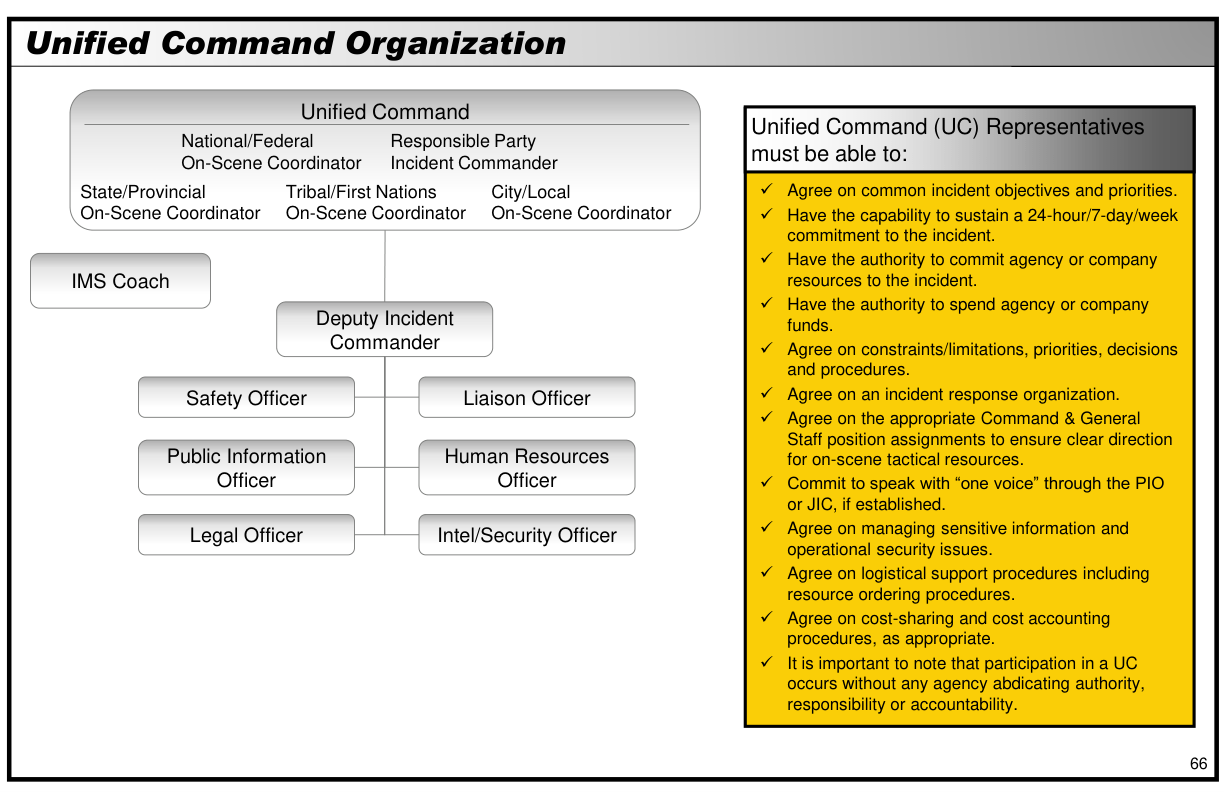
Unified Command
National/Federal On-Scene Coordinator
Responsible Party Incident Commander
State/Provincial On-Scene Coordinator
Tribal/First Nations On-Scene Coordinator
City/Local On-Scene Coordinator
Deputy Incident Commander
Intel/Security Officer
Unified Command (UC) Representatives must be able to:
v Agree on common incident objectives and priorities.
v Have the capability to sustain a 24-hour/7-day/week commitment to the incident.
Have the authority to commit agency or company resources to the incident.
Have the authority to spend agency or company funds.
v Agree on constraints/limitations, priorities, decisions and procedures.
v Agree on an incident response organization.
v Agree on the appropriate Command & General Staff position assignments to ensure clear direction for on-scene tactical resources.
Commit to speak with "one voice" through the PIO or JIC, if established.
Agree on managing sensitive information and operational security issues.
v Agree on logistical support procedures including resource ordering procedures.
v Agree on cost-sharing and cost accounting procedures, as appropriate.
v It is important to note that participation in a UC occurs without any agency abdicating authority, responsibility or accountability.
| Handbook Page | 66–69 (PDF p.128–131) |
| Part | B — Incident Management |
| Section | 3.3 Unified Command Organization |
| Type | reference |